The Skyscraper New York Tore Down: The Lost Singer Building
In our previous story, Manhattan’s Vanished Giants: Three Skyscrapers That Disappeared, we looked at three enormous towers that once stood on the island of Manhattan—and the very different circumstances that caused each of them to disappear. One of those losses raises a more difficult question. The Singer Building was not a casualty of disaster. It was a celebrated piece of New York history that the city knowingly allowed to come down. This is its story.
What does a city decide is worth saving?
We tend to think of great buildings as permanent. Stone feels permanent. Steel feels permanent. A skyscraper that once held the title of tallest building in the world seems as though it should be especially permanent—a landmark that future generations would naturally inherit.
But it wasn’t.
For sixty years, the Singer Building rose above the corner of Broadway and Liberty Street in Lower Manhattan. It survived the arrival of taller skyscrapers. It survived a world war, the Great Depression, another world war, changing businesses, changing architecture, and a skyline that seemed determined to reinvent itself every few years.
What it could not survive was a changing definition of value.
By the late 1960s, one of the most important skyscrapers in New York history was being taken apart.
Floor by floor.
Steel by steel.
Gone.
Before Woolworth, Singer Owned the Sky
The Singer Manufacturing Company was already one of the world’s great businesses by the beginning of the twentieth century. Singer sewing machines had transformed domestic and industrial sewing, and the company’s name was recognized far beyond the United States.
Its headquarters stood at Broadway and Liberty Street, where architect Ernest Flagg had previously designed a much smaller office building for the company. But Singer wanted something more.
Something that could be seen.
Something that could not be ignored.
Construction on the great Singer Tower began in 1906. When it was completed in 1908, the building rose 612 feet above Lower Manhattan. According to the Council on Vertical Urbanism’s Skyscraper Center, the tower reached approximately 670 feet when its flagpole was included.
The scale was extraordinary for its time.
The previous record-holder, the Park Row Building, had stood roughly 226 feet shorter. The Skyscraper Museum describes the Singer Tower as a red-brick and bluestone Beaux-Arts skyscraper whose slender form required sophisticated wind bracing and expensive caisson foundations. It had been built in only about twenty months after its foundations were set.
New York had entered a different age.
The race upward had begun.
A Building Designed to Be Remembered
The Singer Building did not simply rise above its neighbors. It announced itself.
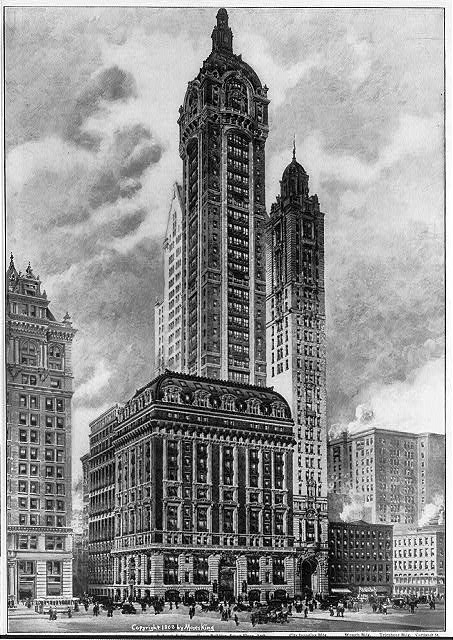
Its narrow tower emerged from a broad office base, ending in an elaborate mansard-like crown, lantern, arches, balconies, stone ornament, copper details, and a flagpole stretching even farther into the sky.
There was nothing timid about it.
Inside, Singer continued the spectacle.
The New York Preservation Archive Project describes a lobby filled with marble columns, bronze trim, decorative plaster domes, and Singer medallions incorporating the imagery of a needle and thread. Contemporary descriptions compared its glowing interior to the luminous architecture of the 1893 World’s Columbian Exposition.
Visitors could even pay 50 cents to ascend to an observation level high above Manhattan.
Imagine the view in 1908.
No Empire State Building.
No Chrysler Building.
No World Trade Center.
Not even the Woolworth Building.
Below were church spires, masonry office buildings, crowded streets, ferries moving across the harbor, smoke rising from rooftops, and a city that still looked very different from the vertical Manhattan we recognize today.
From the Singer Tower, New York must have seemed almost small.
Tallest in the World—For One Year
There is something strangely human about the Singer Building’s greatest achievement.
It lasted almost no time at all.
In 1908, Singer became the tallest building in the world.
In 1909, the 701-foot Metropolitan Life Insurance Company Tower rose above it.
Four years later, in 1913, the title returned downtown when Frank W. Woolworth’s new skyscraper reached 792 feet above Broadway. The Skyscraper Museum documents that remarkable progression: Singer, Metropolitan Life, then Woolworth.
Three record-breaking buildings.
Five years.
New York was no longer merely building skyscrapers. It was competing with itself.
And the Singer Building, for all its grandeur, became yesterday’s record almost immediately.
But losing the title did not make it unimportant.
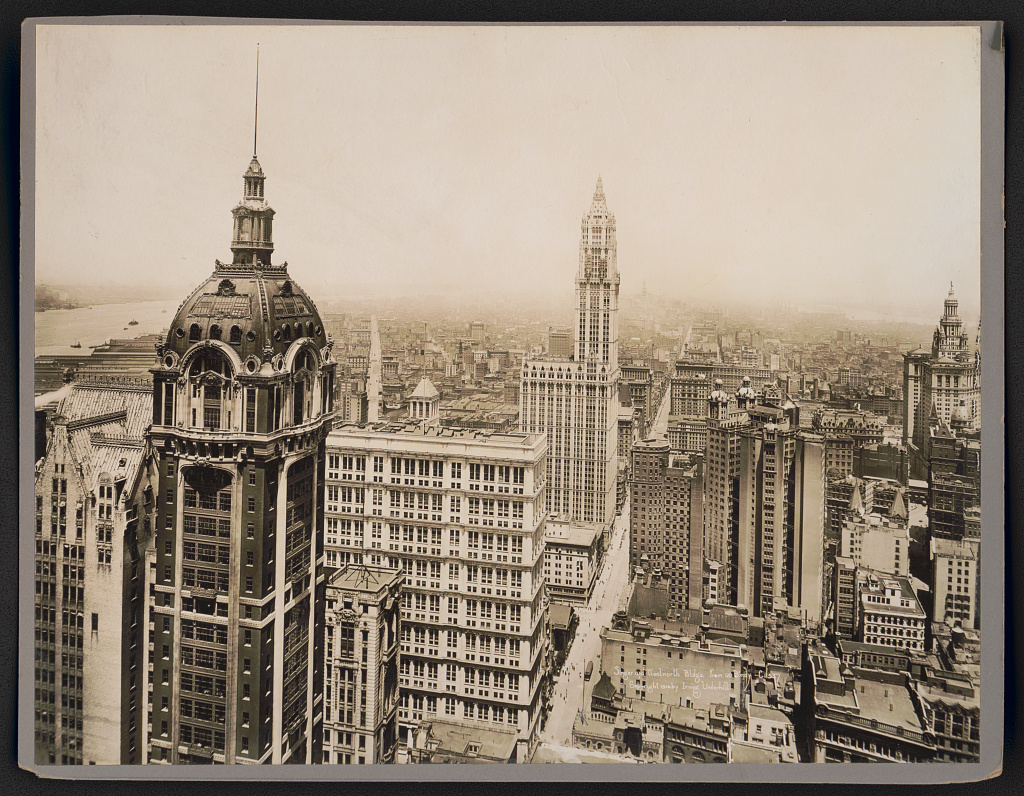
The tower remained one of the defining forms of the Lower Manhattan skyline for decades, standing within sight of the Woolworth Building that had eventually surpassed it.
A remarkable Library of Congress photograph from around 1916 captures both buildings in the same view: Singer’s rounded crown in the foreground and Woolworth’s Gothic tower farther up Broadway. The image almost seems to preserve the transition between two generations of skyscraper ambition. The Library of Congress lists no known restrictions on publication for this photograph.
One had been the tallest.
The other became taller.
One survives.
The other does not.
Then the Word “Obsolete” Appeared
Buildings age differently than people do.
A building can remain beautiful while becoming financially inconvenient.
It can remain historically important while becoming inefficient.
It can be admired and unwanted at the same time.
By 1961, the Singer Sewing Machine Corporation had concluded that its celebrated headquarters was obsolete for the company’s needs and moved its offices uptown. The property was sold to the development firm Webb & Knapp.
The Singer Building’s narrow tower—the very quality that had made its silhouette so elegant—did not provide the enormous, open office floors increasingly desired by modern corporations.
The qualities that made the building distinctive had become liabilities.
Webb & Knapp also acquired the neighboring City Investing Building, another enormous early skyscraper occupying the block. The company’s original hope was to relocate the New York Stock Exchange there. That plan failed.
Then, in 1964, United States Steel purchased the site.
Its plan was not to rehabilitate the old buildings.
It was to erase them.
Could the Singer Building Have Been Saved?
This is the part of the story that becomes difficult.
Because by the 1960s, New York already understood what architectural loss looked like.
The demolition of the original Pennsylvania Station had horrified many New Yorkers. In response to the mounting destruction of historically important buildings, Mayor Robert F. Wagner signed New York City’s Landmarks Law in April 1965, creating the Landmarks Preservation Commission.
The Singer Building seemed like exactly the kind of structure such a commission should protect.
It had been the tallest building in the world.
It represented a critical moment in skyscraper engineering.
It was architecturally distinctive.
It had helped transform New York’s skyline.
And people knew it was important.
As early as 1963, preservationist Alan Burnham had included Singer alongside the Metropolitan Life Tower and Woolworth Building in an inventory of important New York landmarks.
But recognizing that something matters and being able to save it are not the same thing.
Burnham understood the problem. If the city designated Singer as a landmark, the owner would be left with a commercially difficult skyscraper on extraordinarily valuable Lower Manhattan property.
He explained the dilemma plainly:
“If the building were made a landmark, we would have to find a buyer for it or the city would have to acquire it.”
The new Landmarks Preservation Commission did not have the money, staff, or political strength to become a real-estate broker for a skyscraper.
Singer was never designated.
Time was running out.
The Tallest Building Ever Deliberately Demolished
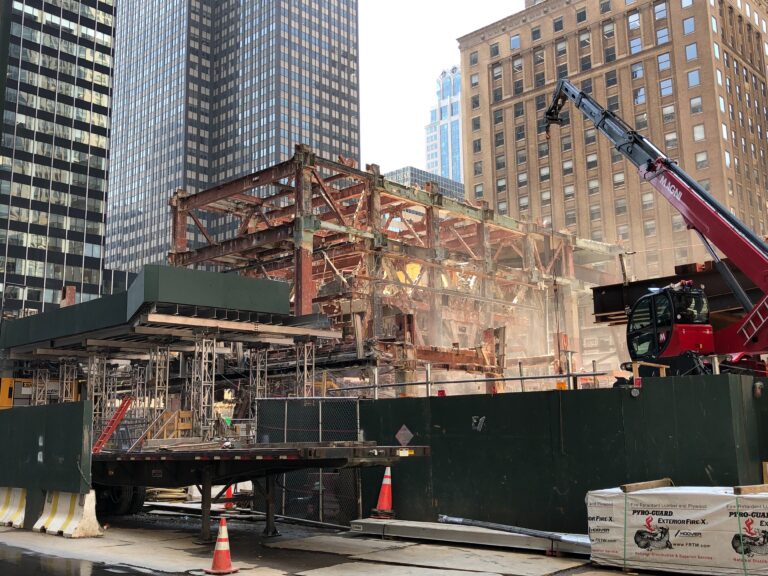
Demolition began in 1967, with the tower gone by 1968.
There was no dramatic implosion.
No single explosion.
A skyscraper surrounded by the dense streets and buildings of Lower Manhattan could not simply be blown apart.
Instead, the Singer Building was dismantled.
Slowly.
Its elaborate crown disappeared. Floors were stripped away. Masonry came down. Steel framing was exposed and removed. The famous tower grew shorter and shorter until the building that had once dominated the New York skyline no longer existed.
At 612 feet, Singer became the tallest skyscraper ever intentionally demolished—a record it would hold for more than half a century. The Skyscraper Center records its status as demolished in 1968 and notes that it was razed specifically to make way for One Liberty Plaza.
It is difficult not to see the irony.
In 1908, engineers had pushed the limits of technology to make it rise.
Sixty years later, workers used enormous effort to make it disappear.
What Was Lost?
A city cannot preserve everything.
Buildings must sometimes change. Businesses grow. Technology evolves. Neighborhoods adapt. Cities that never change become museums rather than living places.
I understand that.
But there is a difference between change and erasure.
The Singer Building was not an anonymous office block that happened to grow old. It represented a moment when architects and engineers were still discovering what a skyscraper could be. It belonged to the generation that transformed New York from a city of masonry buildings and church steeples into the vertical metropolis recognized around the world.
Its loss was not merely the loss of 612 feet of steel and stone.
It was the loss of evidence.
Evidence of ambition.
Evidence of experimentation.
Evidence of what New York had once believed a skyscraper should look like.
The New York Preservation Archive Project notes that the AIA Guide to New York City later characterized Singer’s destruction as the city’s greatest architectural loss since Pennsylvania Station. Only a handful of physical pieces survive; chandeliers from the Singer lobby were salvaged and installed at Pratt Institute in Brooklyn.
The building itself survives only in photographs, drawings, documents, memories—and the skyline around it.
One Liberty Plaza Takes Its Place
Singer did not disappear alone.
The neighboring City Investing Building was also demolished, clearing an entire Lower Manhattan block for United States Steel’s new headquarters.
The replacement was what we now know as One Liberty Plaza.
Completed in 1973, the 54-story tower rises 743 feet, substantially taller than Singer. Designed by Skidmore, Owings & Merrill, it used exposed structural steel as an architectural statement—a fitting headquarters for U.S. Steel. SOM describes it as New York City’s first high-rise office building with an exposed steel structure.
The contrast could hardly be greater.
Singer celebrated business through marble, bronze, arches, ornament, a dome and a lantern.
U.S. Steel celebrated business through structure, efficiency, enormous floor plates and an exposed steel grid.
Both buildings advertised the companies behind them.
They simply spoke completely different architectural languages.
One represented the skyscraper city of 1908.
The other represented the corporate city of the 1970s.
Progress had changed its appearance.
The Building That Survived
And then there is the Woolworth Building.
Singer became the world’s tallest building in 1908.
Metropolitan Life surpassed it in 1909.
The Woolworth Building surpassed them both in 1913 and remained the world’s tallest office building for more than seventeen years.
Today, Singer is gone.
The Woolworth Building still stands at 233 Broadway.
Its Gothic tower still rises above City Hall Park. Its lobby still contains marble, mosaics, sculpture, gold leaf, vaulted ceilings, and the architectural details created more than a century ago. And because that building survived, we do not have to rely entirely upon photographs to understand the ambition of New York’s first great skyscraper age.
We can still step inside it.
The officially authorized Woolworth Building tour offers rare access to the historic lobby, triptych balcony, and first sub-level vault while exploring Frank W. Woolworth, architect Cass Gilbert, and the extraordinary race to build higher in early twentieth-century New York.
The former Singer Building site is also one of the architectural stories explored on Woolworth Tours NYC’s A Walk Up Broadway, which follows Broadway from Bowling Green to City Hall Park through nearly four centuries of New York history.
Stand on Broadway and Liberty Street today and look at One Liberty Plaza.
There is almost nothing there to tell you what once occupied the same sky.
No tower.
No dome.
No observation deck.
No Singer sign glowing over Lower Manhattan.
That may be the most powerful part of the story.
What Does a City Choose to Remember?
New York has always rebuilt itself.
That restlessness is part of what made it extraordinary. Buildings rise because someone believes the future can be larger, taller, faster, richer, more efficient, more impressive than the present.
Singer itself was born from that ambition.
So was Woolworth.
So was One Liberty Plaza.
But progress creates a difficult responsibility. Every generation inherits a city it did not build entirely for itself. Some things belong not only to their owners, developers, tenants, or investors, but also to the historical memory of everyone who comes afterward.
The Singer Building was once the tallest building on Earth.
Then it became commercially inconvenient.
Then it became debris.
Today, we can look at photographs and wonder how New York ever allowed such a building to disappear.
Perhaps that is one reason surviving landmarks matter so much.
They remind us that permanence is never guaranteed.
Someone has to decide that a building is worth keeping.
Someone has to protect it.
And sometimes, by the time we understand what we are losing, it is already too late.
Sources and Further Reading
- Council on Vertical Urbanism / The Skyscraper Center. Singer Building. Building data, height, construction chronology, and demolition history. The Skyscraper Center — Singer Building
- The Skyscraper Museum. Singer Building. History, architecture, engineering, construction, and its world-height record. The Skyscraper Museum — Singer Building
- The Skyscraper Museum. Skyline Through 1916. Singer, Metropolitan Life, and Woolworth in New York’s early skyscraper height race. The Skyscraper Museum — Skyline Through 1916
- New York Preservation Archive Project. Singer Building. Preservation history, Singer’s departure, sale of the site, failed NYSE proposal, U.S. Steel acquisition, landmark discussions, demolition, and surviving chandeliers. NYPAP — Singer Building
- New York City Landmarks Preservation Commission. About LPC. History of the 1965 Landmarks Law and creation of the commission following major architectural losses including Pennsylvania Station. NYC Landmarks Preservation Commission
- Skidmore, Owings & Merrill. One Liberty Plaza. History and architectural design of the building that replaced the Singer and City Investing buildings. SOM — One Liberty Plaza
- Library of Congress, Prints and Photographs Division. Singer and Woolworth Bldgs. from 120 B’way, c. 1916. No known restrictions on publication. Reproduction no. LC-DIG-ppmsca-54244. Library of Congress photograph record
- Woolworth Tours NYC. A Walk Up Broadway. A Walk Up Broadway
- Woolworth Tours NYC. Official Woolworth Building Tour. Woolworth Building Tour