Manhattan’s Vanished Giants: Three Skyscrapers That Disappeared
New York is usually judged by what it builds.
The towers that reached higher. The buildings that broke records. The architects who changed the skyline. Steel, stone, glass, money, ambition—each generation adding another layer to a city that has never been particularly interested in standing still.
But what if we looked at New York from the opposite direction?
What did it lose?
What was enormous, important, expensive, and seemingly permanent—and then simply disappeared?
Three remarkable answers once stood on the island of Manhattan.
At 270 Park Avenue in Midtown stood a 707-foot corporate skyscraper that eventually became the headquarters of JPMorgan Chase.
At Broadway and Liberty Street in Lower Manhattan stood the 612-foot Singer Building.
And only a few blocks farther west, at 130 Liberty Street beside the World Trade Center, stood the 517-foot building eventually known as the Deutsche Bank Building.
Historical note: You may see the height of the Deutsche Bank Building listed as either 517 feet or 535 feet in different sources. For this article, we use 517 feet, the figure given by Thornton Tomasetti, the engineering firm responsible for the building’s stabilization and deconstruction, and also recorded by the Council on Vertical Urbanism. Thornton Tomasetti identifies 130 Liberty Street as a 42-story, 517-foot tower.
Three skyscrapers.
Three different generations of New York.
Three very different reasons for coming down.
And today, all three are gone.
Three Giants on One Island
They were not, as it might first appear, all clustered on the same block.
The former 270 Park Avenue stood in Midtown, between 47th and 48th Streets, about 3.7 miles north of the Singer Building site in a straight line.
But the other two were remarkably close.
The Singer Building stood at Broadway and Liberty Street.
The Deutsche Bank Building stood at 130 Liberty Street, immediately south of the World Trade Center.
Their former sites were only about 700 feet apart as the crow flies—roughly one-eighth of a mile.
The same small section of Lower Manhattan.
The same Liberty Street corridor.
You could walk from one former site to the other in minutes.
Yet the buildings belonged to completely different New Yorks.
Singer came from the exuberant first great age of skyscraper construction.
The Deutsche Bank Building belonged to a much later generation of modernist Financial District architecture, opening more than sixty years after Singer.
And several miles north, 270 Park Avenue represented yet another era: postwar corporate New York.
All three eventually vanished.
That is what makes them fascinating together.
Not because they shared an architect, an owner, or even a reason for demolition.
They didn’t.
What they shared was Manhattan.
And Manhattan has never treated height as a guarantee of permanence.
270 Park Avenue: When an Entire Skyscraper Became the Starting Point
The former building at 270 Park Avenue was completed in 1960 as the headquarters of Union Carbide Corporation.
Designed by Skidmore, Owings & Merrill, with Gordon Bunshaft and Natalie de Blois associated with the design, the International Style tower rose 707 feet and 52 stories above Midtown.
That alone should give us some perspective.
Seven hundred and seven feet.
In many American cities, a building of that size would define the skyline.
In Manhattan, it eventually became something that could be replaced.
Over the decades the building passed into the hands of major financial institutions and ultimately became JPMorgan Chase’s headquarters. By the twenty-first century, however, the company wanted to consolidate more employees into a larger building on the same site.
Not across town.
Not on another block.
On the same ground.
So the existing skyscraper had to go.
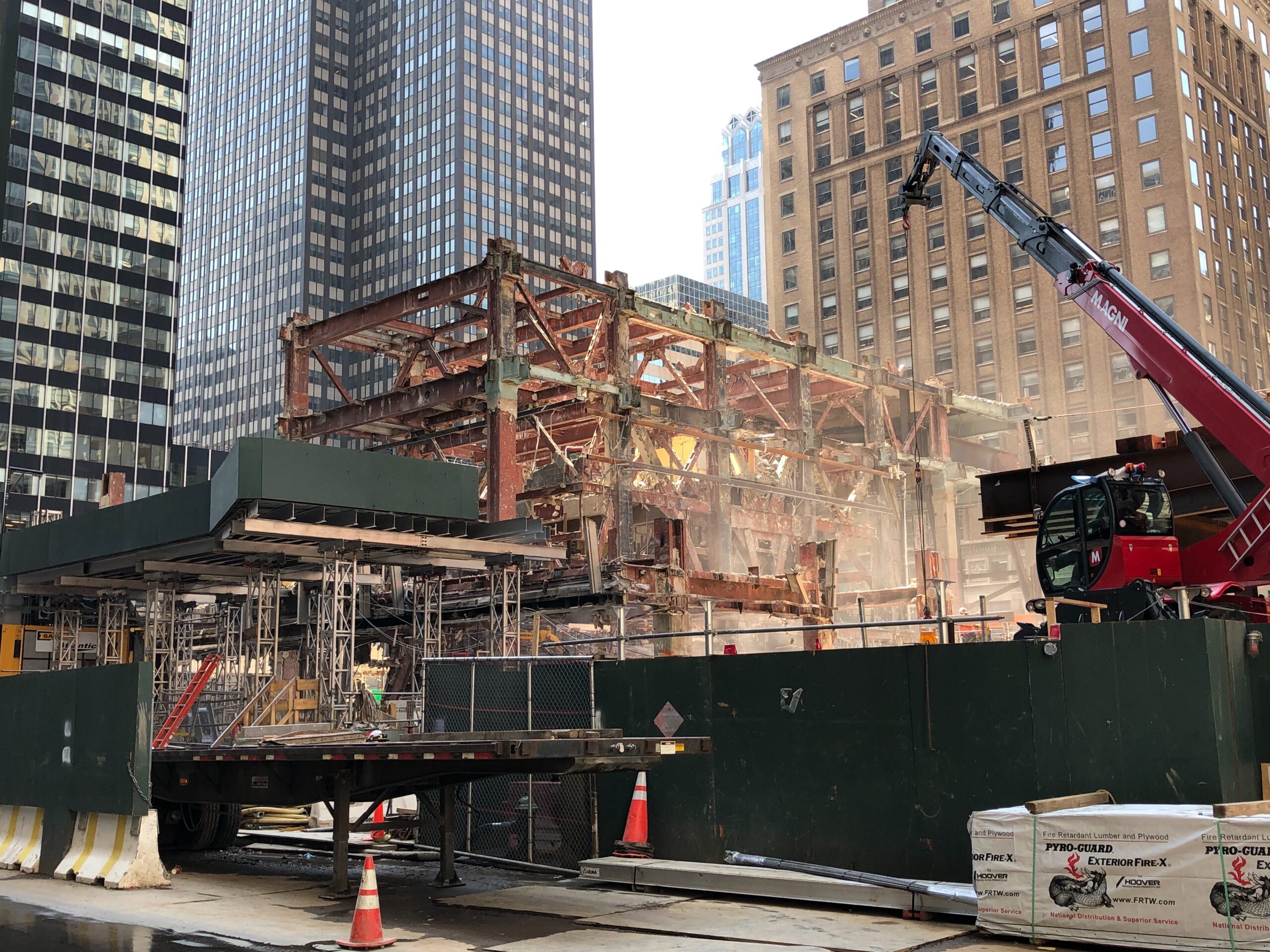
The dismantling began in 2019 and was completed in 2021. At the time, 270 Park Avenue became the tallest building in the world ever voluntarily demolished, surpassing a record another Manhattan skyscraper had held for decades.
The Singer Building.
We will come back to that.
What happened next at Park Avenue almost perfectly summarizes the way New York thinks about real estate.
The old tower was 707 feet tall.
Its replacement rises 1,388 feet.
The new JPMorganChase headquarters opened in 2025, occupying the same Park Avenue block with approximately 2.5 million square feet of space and room for thousands of employees.
The old skyscraper had not been tiny.
It had not vanished into insignificance beside its neighbors.
It simply was no longer enough.
There is something almost unsettling about that.
How large must a New York building become before the city considers it permanent?
Apparently, 707 feet was not the answer.
Then There Was Singer
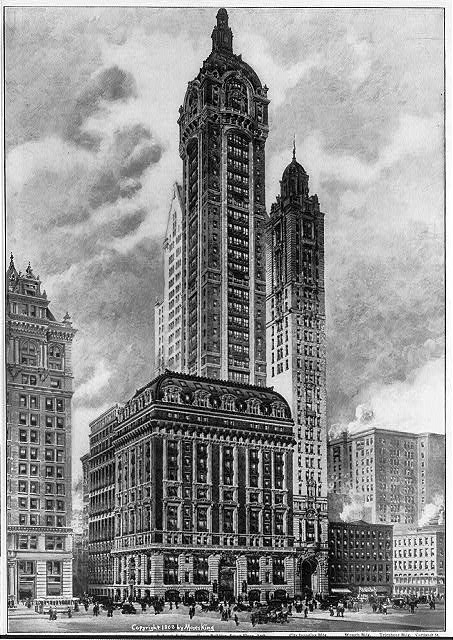
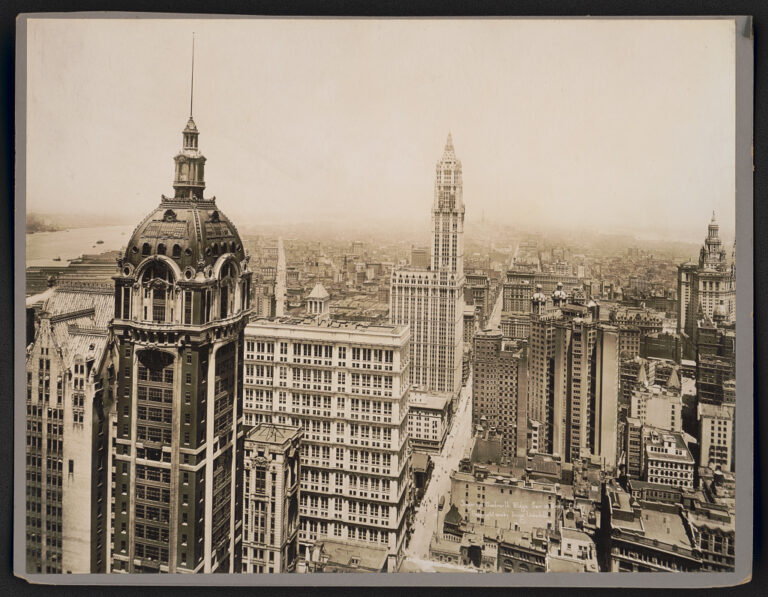
Credit: Library of Congress, Prints and Photographs Division.
Several miles south, New York had already faced a remarkably similar question.
At Broadway and Liberty Street stood the Singer Building.
It rose 612 feet, and for a brief period after its completion in 1908, no skyscraper in the world stood higher.
That fact alone should make what happened to it difficult to comprehend.
But Singer’s story is not simply another example of an old building being replaced by a newer one.
It raises much larger questions about architectural value, preservation, economics, and the strange point at which a building can be historically priceless and commercially inconvenient at exactly the same time.
For decades, Singer held an unusual record: it was the tallest building ever intentionally demolished.
Then 270 Park Avenue finally surpassed it.
The two buildings stood more than three miles apart and belonged to completely different architectural generations, yet their endings were connected by the same basic New York impulse:
The site could hold something more.
What made Singer worth sacrificing?
Could it have survived?
And how did a building important enough to have once stood above the entire world become expendable?
Those questions deserve their own story.
And they will get one.
For now, continue west along Liberty Street.
Because Singer was not the only giant to disappear from this small part of Lower Manhattan.
Only a Few Blocks Away
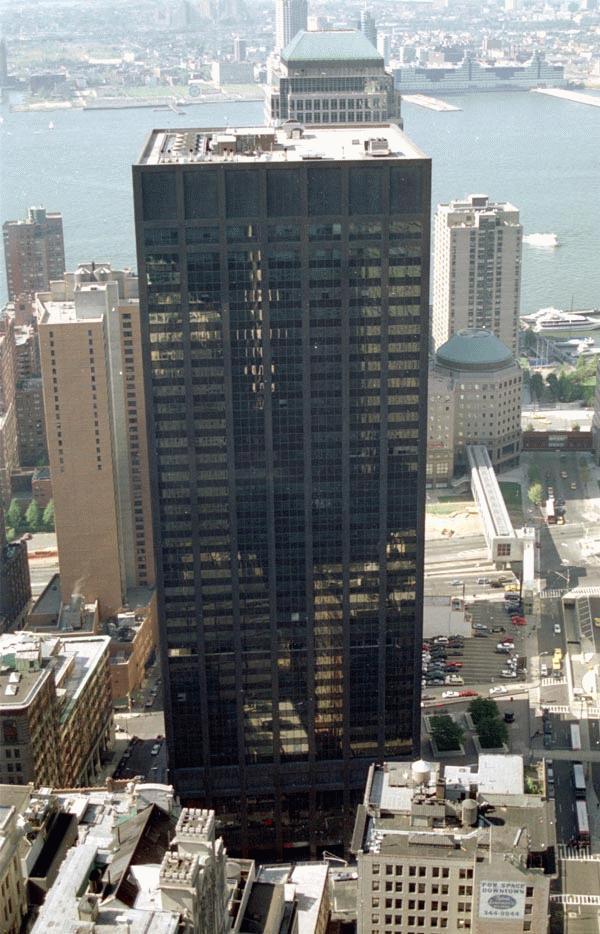
Photo: Scott Murphy, via Wikimedia Commons. Public domain.
From Broadway and Liberty Street, head toward the World Trade Center.
The distance is so short that it almost seems impossible that two skyscrapers of this scale could have vanished from such a small area.
At 130 Liberty Street, directly south of the original World Trade Center, stood another enormous office tower.
It opened in 1974 as Bankers Trust Plaza.
Later, after Deutsche Bank acquired Bankers Trust, it became commonly known as the Deutsche Bank Building.
It rose 517 feet over Lower Manhattan.
Unlike Singer, its disappearance was never part of an ordinary redevelopment plan.
Its story changed on September 11, 2001.
The Skyscraper That Survived September 11—but Never Reopened
When the South Tower of the World Trade Center collapsed, debris struck 130 Liberty Street.
The Deutsche Bank Building remained standing.
That distinction matters.
The Twin Towers were destroyed in the terrorist attacks. The Deutsche Bank Building was not.
But remaining upright did not mean returning to normal.
The structure sustained significant damage, while dust and debris from the World Trade Center entered the building and contaminated portions of its interior. The building remained unoccupied after September 11.
What should happen to it was not immediately settled. Its condition became the subject of litigation between Deutsche Bank and the building’s insurers. In 2004, the Lower Manhattan Development Corporation acquired 130 Liberty Street from Deutsche Bank and moved forward with a plan to clean and deconstruct the building.
What followed was not a conventional demolition.
It was an enormously complicated process of stabilization, environmental remediation, and systematic deconstruction.
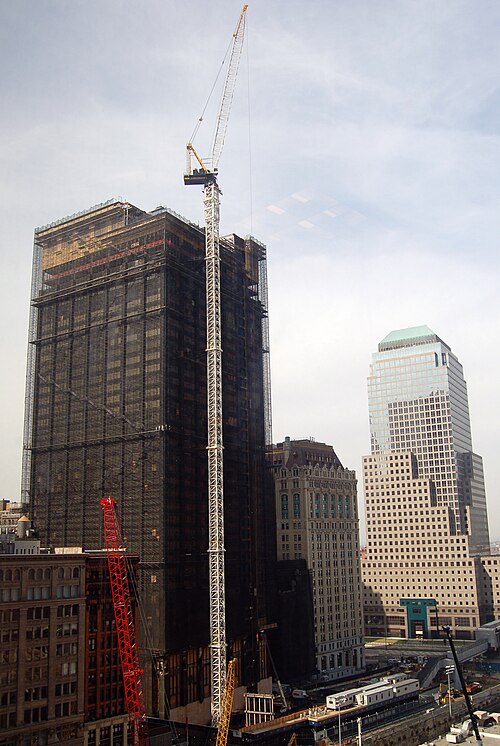
Photo: Mike Roberts / Wikimedia Commons, CC BY 2.0.
Thornton Tomasetti, the engineering firm retained for the project, describes a phased process in which the damaged structure first had to be analyzed and stabilized with bracing and shoring. Deconstruction then had to proceed alongside environmental abatement.
The building could not simply come down.
It had to be taken apart under conditions created by one of the worst disasters in American history.
And the process itself brought further tragedy.
On August 18, 2007, a fire broke out inside the building during the deconstruction project. Two New York City firefighters, Joseph Graffagnino and Robert Beddia, were killed.
Work was halted.
Investigations followed.
Eventually the painstaking removal resumed, and the deconstruction was finally completed in 2011.
A building that had closed on September 11, 2001, remained part of the altered World Trade Center landscape for nearly another decade.
It survived the attacks.
But it never recovered from them.
Look at the Distance Between Them
This is where a map changes the story.
The former Singer Building site and the former Deutsche Bank Building site were separated by only about 700 feet.
That means a person walking through Lower Manhattan today can move between the locations of two vanished skyscrapers in a matter of minutes without seeing either one.
At one end is the black steel mass of One Liberty Plaza, occupying the block where Singer once rose.
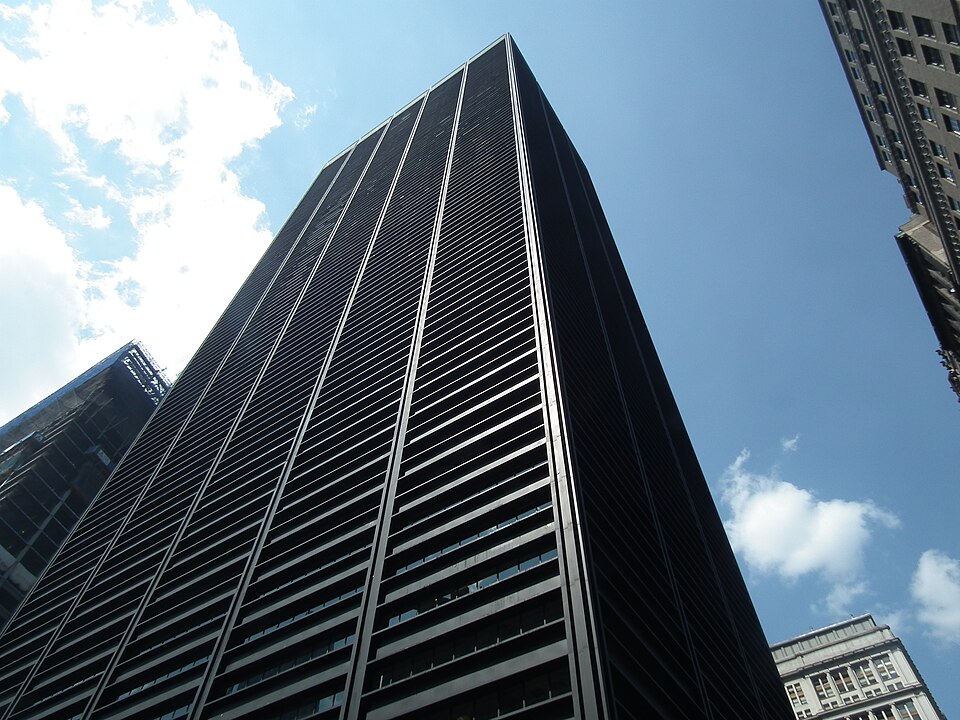
Photo: Erik Drost / Wikimedia Commons, CC BY 2.0.
Farther west is the rebuilt World Trade Center district, transformed almost beyond recognition since September 11.
If nobody tells you what came before, the present begins to feel inevitable.
Of course One Liberty Plaza belongs there.
Of course the World Trade Center looks the way it does.
Of course these streets have always looked like this.
Except they haven’t.
That is one of the reasons walking through New York with its history in mind can completely change the city.
The buildings we see are only one layer.
Beneath them are other buildings.
Other businesses.
Other streets.
Other lives.
Other versions of New York.
Some survived.
Some did not.
Walking Through a City of Absences
This is especially true in Lower Manhattan, where Woolworth Tours NYC spends so much of its time.
Our A Walk Up Broadway follows Broadway from Bowling Green to City Hall Park through nearly four centuries of New York history. Along the way, guests encounter surviving landmarks—but also places where the landmark itself has disappeared.
The former Singer Building site is one of them.
That matters because a walking tour is not only about pointing at what remains.
Sometimes the story is in the empty space.
Sometimes it is in the replacement.
Sometimes the most important thing a guide can say is:
Look here. Now imagine something completely different.
The Broadway we walk today is layered over the Broadway of 1908, 1776, Dutch New Amsterdam, the nineteenth-century commercial city, and every generation in between. The tour specifically includes the former Singer Building site among the places that helped define New York’s rise as a center of commerce and architecture.
A few blocks west, the Oculus at the World Trade Center: Architecture & History Tour explores another landscape shaped as much by what disappeared as by what was rebuilt.
That tour moves through the evolution of the World Trade Center site—from the neighborhood that preceded the original complex, through September 11, and into the architecture and reconstruction visible today.
The former Deutsche Bank Building is part of that larger geography of loss and rebuilding.
It stood just beyond the World Trade Center.
It was damaged because of what happened there.
And its decade-long removal became part of the complicated story of Lower Manhattan’s recovery.
These places are close enough that the stories overlap geographically even when they belong to different chapters of history.
That is Lower Manhattan.
Everything is close.
And almost nothing is simple.
Why So Much Change Here?
There is a reason Manhattan has produced stories like these.
Land is limited.
Demand is enormous.
Architecture changes.
Businesses change.
Technology changes.
A building designed brilliantly for one generation may frustrate the next.
And in a city where a single block can be worth an extraordinary amount of money, the pressure to use that land more intensely never really disappears.
This has produced some of the greatest architecture in the world.
It has also destroyed some of it.
That contradiction is important.
New York’s willingness to reinvent itself gave us the skyline.
The same willingness erased parts of the skyline that came before it.
We cannot celebrate one without at least acknowledging the other.
Three Buildings. Three Endings.
The stories of these towers should not be treated as though they were the same.
They weren’t.
270 Park Avenue was intentionally removed so JPMorgan Chase could build a dramatically larger headquarters on the same property.
The Singer Building disappeared during an earlier age of Lower Manhattan redevelopment, when the economics of a valuable site collided with the value of an aging but historically extraordinary skyscraper.
The Deutsche Bank Building became a casualty of September 11 and its aftermath—a standing tower left significantly damaged and contaminated after the attacks. It remained vacant while its condition became the subject of litigation, and after the Lower Manhattan Development Corporation acquired the property in 2004, the building was cleaned and systematically deconstructed under extraordinary conditions.
Development.
Redevelopment.
Disaster.
Three very different forces.
One result.
The buildings disappeared from Manhattan.
And the city built again.
What Remains Changes How We Understand What Was Lost
This is also why the survival of Manhattan’s historic buildings matters.
A photograph can show us a vanished skyscraper.
A map can tell us where it stood.
A historian can describe it.
But standing inside a building that actually survived creates a different relationship with the past.
The Woolworth Building is one of those survivors.
Completed during the same great era of early skyscraper ambition that produced Singer, it still rises above Broadway and City Hall Park. Woolworth Tours NYC’s officially authorized Woolworth Building Tour allows visitors to enter its historic lobby and experience architecture that otherwise might exist only in photographs and descriptions.
That contrast matters.
Manhattan contains what survived beside what replaced the things that did not.
To understand the city, we need both.
One Story Is Harder to Let Go
Of these three vanished towers, the ending of one remains especially difficult to reconcile.
270 Park Avenue was enormous, but something much larger replaced it.
The Deutsche Bank Building became entangled in an unprecedented disaster from which it never recovered.
The Singer Building presents a different problem.
Nothing catastrophic happened to it.
Yet the building disappeared.
And this was not just any skyscraper.
It had once held one of architecture’s most coveted titles.
For decades after its destruction, it remained the tallest building anyone had ever deliberately taken down.
Today, stand at Broadway and Liberty Street and you will find almost no physical evidence that it was ever there.
So how did that happen?
How does a building go from a symbol of the future to an obstacle standing in its way?
And what does the loss of Singer tell us about the things a changing city decides are—and are not—worth saving?
That is where our next story begins.
Next: The Skyscraper New York Tore Down: The Lost Singer Building.
Sources and Further Reading
Council on Vertical Urbanism / The Skyscraper Center — Singer Building
Building height, world-height status and demolition history.
https://www.skyscrapercenter.com/new-york-city/singer-building/2080/
Thornton Tomasetti — Deutsche Bank Building Deconstruction
Engineering record of 130 Liberty Street, including its 517-foot height, September 11 damage, stabilization and deconstruction completed in 2011.
https://www.thorntontomasetti.com/project/deutsche-bank-building-deconstruction
Skidmore, Owings & Merrill / historical records of the Union Carbide Building
Architecture and history of the former 270 Park Avenue.
JPMorganChase — 270 Park Avenue
Information about the current 1,388-foot headquarters that replaced the former tower.
https://www.jpmorganchase.com/newsroom/press-releases/2025/grand-opening-270-park
Woolworth Tours NYC — A Walk Up Broadway
Historic walking tour from Bowling Green to City Hall Park, including the former Singer Building site.
https://woolworthtoursnyc.com/a-walk-up-broadway/
Woolworth Tours NYC — Oculus at the World Trade Center
Architecture and history tour covering the evolution, destruction and reconstruction of the World Trade Center district.
https://woolworthtoursnyc.com/oculus/
Woolworth Tours NYC — Official Woolworth Building Tour
Interior architecture and history of one of Lower Manhattan’s great surviving early skyscrapers.
https://woolworthtoursnyc.com/woolworth-building/