The Night Titanic’s Tragedy Reached Broadway: Waiting for News at 9 Broadway
How does a family wait for news when there is no one who can give it?
Today, information travels almost instantly. We receive alerts on our phones. We watch events unfold through live video, social media, and continuous news coverage. We may still be frightened. We may still be helpless. But we expect to know.
In April 1912, knowing was not so simple.
News crossed the Atlantic through wireless messages—short, incomplete, delayed, misunderstood. One message offered hope. Another contradicted it. A person could believe a loved one had been rescued in the afternoon and learn that the ship was gone by nightfall.
And so they waited.
They waited beside telephones. They waited for telegrams. They searched newspaper reports for familiar names. Eventually, many could no longer remain at home.
They went to Broadway.
A Ship Bound for New York
The Titanic left Southampton, England, on April 10, 1912, beginning its maiden voyage across the Atlantic. It was enormous, luxurious, technologically impressive; a powerful symbol of a world becoming increasingly confident in its ability to overcome distance, nature, and danger.
Its destination was New York.
The people aboard represented many different lives. There were wealthy industrialists and celebrated public figures; businessmen, newlyweds, parents, children, servants, crew members, and immigrants traveling toward the possibility of a different future.
Some were returning home.
Some were leaving home behind.
Some expected family members to meet them when they arrived.
The arrival never happened.
At approximately 11:40 p.m. on April 14, the Titanic struck an iceberg in the North Atlantic. At approximately 2:20 the following morning, the ship disappeared beneath the water. More than 1,500 people died. Roughly 700 survived, rescued from the lifeboats by the Carpathia. Historical totals vary slightly because passenger and crew records were not entirely consistent. The National Archives’ Titanic exhibit provides additional information about the voyage, the collision, the lifeboats, and the loss of life.
The disaster took place hundreds of miles from land. But its emotional impact traveled quickly. Across the ocean. Through wireless signals. Into newspaper offices, private homes—and the offices of the White Star Line on Lower Broadway.
The First News Was Hope
At first, the reports were confused.
The Titanic had struck an iceberg, but perhaps it was still afloat. Passengers had supposedly been transferred safely to other ships. The damaged liner might be towed into port. Early statements from White Star officials gave families reason to believe that the passengers were safe aboard the Carpathia.
Relief.
The ship was damaged, but the passengers were safe. The journey had gone terribly wrong, but their husbands, wives, parents, children, brothers, and sisters would still come home.
The April 16, 1912, edition of the New-York Tribune reported that many people went to bed secure in that belief.
Later information destroyed it.
The ship had not survived.
Most of its passengers had not survived.
The news changed, and with it, everything else.
Hundreds of telephone calls and telegrams poured into the White Star Line offices on Lower Broadway. People wanted facts. Names. Confirmation. Anything that might separate rumor from truth.
By evening, a telephone call was no longer enough.
People began arriving in person.
Waiting at No. 9 Broadway
Shortly after nine o’clock on the evening of April 15, the New-York Tribune reported that “weeping women began to gather” at the White Star offices at No. 9 Broadway. They came seeking news of relatives who had sailed aboard the Titanic.
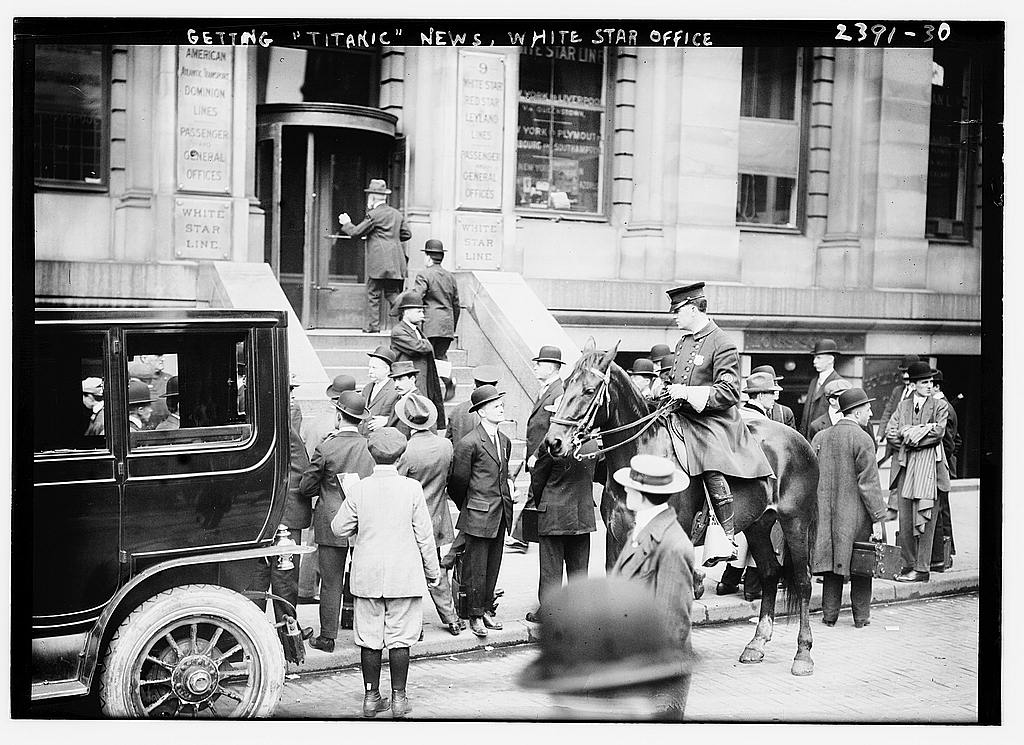
Bain News Service, Library of Congress. Catalog information is based on an unverified original caption.
Imagine that sidewalk.
Automobiles and carriages arriving. Reporters searching for information. Employees moving between offices. Families approaching a desk, speaking names aloud and waiting for someone to recognize them.
Was this person on the survivor list?
Had another message arrived?
Could there have been more lifeboats?
Was another rescue ship still searching?
Hope can be difficult to surrender, even when the facts begin to make it unreasonable. Perhaps especially then.
Mrs. W. Addison Wheelock arrived with her daughter, asking about her sister and brother-in-law, Mary and Daniel Marvin. The young couple had been returning from their honeymoon. White Star employees could give the women only the latest, still-incomplete report.
They broke down sobbing.
A honeymoon.
A beginning.
A life together that had barely begun.
Mary Marvin was among the survivors. Daniel was not. Biographical records maintained by Encyclopedia Titanica document that Mary reached New York aboard the Carpathia, while Daniel died in the sinking.
A short time later, Vincent Astor arrived by automobile with A. J. Drexel and Walter A. Dobbyn, searching for information about his father, John Jacob Astor IV. He was taken into the private office of White Star vice president Philip Franklin. When he emerged, he reportedly had tears in his eyes.
Asked whether he had learned anything about his father, Astor answered that he knew only what he had read in the newspapers.
John Jacob Astor IV was one of the wealthiest men in America.
But wealth could not reach across the Atlantic.
It could not produce a name that had not appeared on a list. It could not force a wireless message to arrive. It could not raise a ship from the ocean.
At No. 9 Broadway, great social distinctions still existed; this was New York in 1912. But fear also created a terrible equality. Wealthy families, ordinary families, public officials, private citizens—all waited for words that might determine the shape of the rest of their lives.
Saved.
Missing.
Dead.
When a Name Becomes Everything
A passenger list is normally an administrative document. Names, ages, nationalities, ticket numbers, destinations.
After a disaster, it becomes something else.
A list becomes hope. A list becomes dread. A name printed beneath the word survivors can restore an entire future. A name that does not appear can leave a family suspended between belief and grief.
The prominent passengers received immediate attention. Newspapers reported on the Astors, Isidor and Ida Straus, Benjamin Guggenheim, Major Archibald Butt, and other well-known travelers.
Their families deserved answers.
But so did everyone else.
The second- and third-class passengers carried stories that were no less important: families separated by immigration, parents bringing children toward a new home, workers traveling toward employment, wives joining husbands who had crossed the Atlantic before them.
Yet information about many of them came slowly. On April 17, the New-York Tribune reported that the names of only a little more than one-third of the survivors had been received and that no list of surviving steerage passengers or crew members had yet arrived.
For some families, even the privilege of knowing was delayed.
This is one of the painful truths within the Titanic story. The ship carried the social structure of its time within it—wealth and poverty, luxury and confinement, visibility and obscurity. The passengers traveled on the same ocean, but they did not experience the voyage in the same way. They did not have the same accommodations, the same access, or the same chances of survival.
National Archives records show that third-class passengers suffered the highest percentage of deaths, and the treatment of passengers by class became part of the official investigation.
And afterward, they were not all remembered in the same way.
History has repeated the names of the wealthy passengers for more than a century. But the loss was not measured only in fortunes, titles, or social position. It was measured in empty places at family tables. Children who never reached their fathers. Husbands who waited for wives. Mothers who lost sons. Lives planned, interrupted, and ended.
The true tragedy was not that the rich and famous died.
It was that people died.
A City Waiting for a Ship That Would Never Arrive
New York had been preparing to receive the Titanic.
Instead, it waited for the Carpathia.
After rescuing survivors from the Titanic’s lifeboats, the Carpathia continued toward New York and arrived on April 18. The National Archives preserves a partial manifest of the Titanic survivors brought into the Port of New York that day.
The people who came ashore had survived the sinking, but survival did not mean that they returned whole.
Many arrived without husbands, fathers, sons, brothers, or friends.
New York received the living.
It also received the first direct witnesses to an enormous loss.
For days, the city had depended on fragments: wireless reports, company statements, newspaper bulletins, rumors. Now survivors could speak. Their presence confirmed life; their stories confirmed death.
The voyage had been presented as a triumph of modern engineering. It ended with frightened survivors, grieving families, and questions that governments would soon be forced to investigate.
How could a ship carrying more than 2,000 people have lifeboat space for only about half of them? Why had repeated warnings not prevented the collision? Why had some lifeboats left partially filled? Who was responsible?
The number of lifeboats aboard the Titanic exceeded the government standard then in effect, but the outdated rules still did not require enough capacity for everyone aboard. The ship could comply with the law while remaining disastrously unprepared.
The system followed the rules.
But the rules failed.
The Investigation Begins
The United States Senate authorized an investigation on April 17, only two days after the sinking. Hearings began at New York’s Waldorf-Astoria Hotel on April 19 and later moved to Washington, D.C.
According to the United States Senate Historical Office, 82 witnesses testified about ignored ice warnings, the inadequate number of lifeboats, the ship’s speed, wireless communication, the failure of nearby vessels to respond, and the treatment of passengers from different classes.
The committee’s final report called for lifeboat capacity for every passenger, better crew training, passenger drills, tighter regulation of wireless communication, and broader improvements to maritime safety.
Disaster revealed what confidence had concealed.
The ship was powerful.
But not invulnerable.
The technology was advanced.
But not enough.
The rules were followed.
But the rules were not sufficient.
The tragedy forced governments and the maritime industry to confront a difficult truth: progress is not measured only by what we are capable of building. It is also measured by how carefully we protect the people who trust what we build.
Broadway and the Age of Ocean Travel
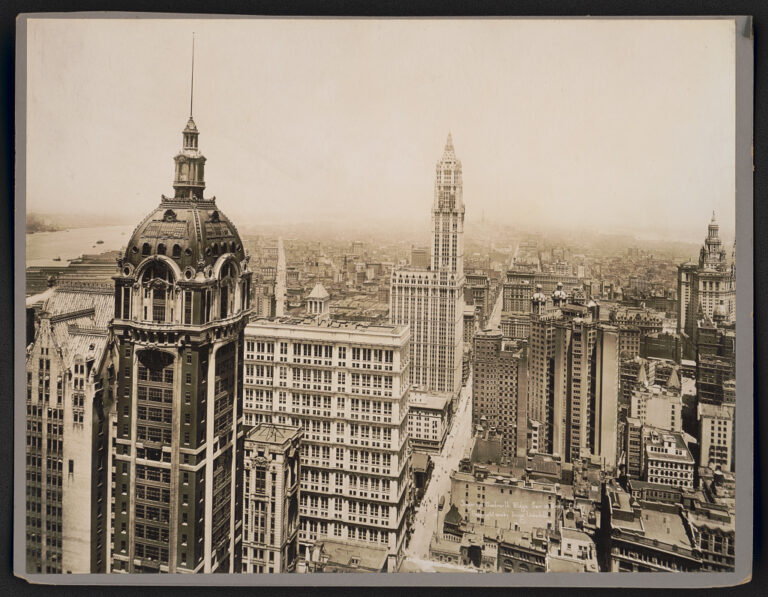
Long before commercial air travel, Lower Broadway connected New York to the rest of the world.
Steamship offices sold tickets, planned voyages, arranged cargo, and managed an international network centered on New York Harbor. Over different periods, major steamship companies maintained prominent offices and headquarters along this corridor.
White Star.
Cunard.
United States Lines.
These companies represented movement, opportunity, commerce, and technological progress. Their ships carried people toward new countries, new work, new relationships, and new lives. The steamship offices along Broadway were not merely corporate addresses; they were places where private hopes became travel arrangements.
But in April 1912, the White Star offices became something very different.
A place built around departure and arrival became a place of waiting.
A company associated with confidence could provide little certainty.
A Broadway address that connected New York to the ocean became the place where the human cost of an ocean disaster reached the city.
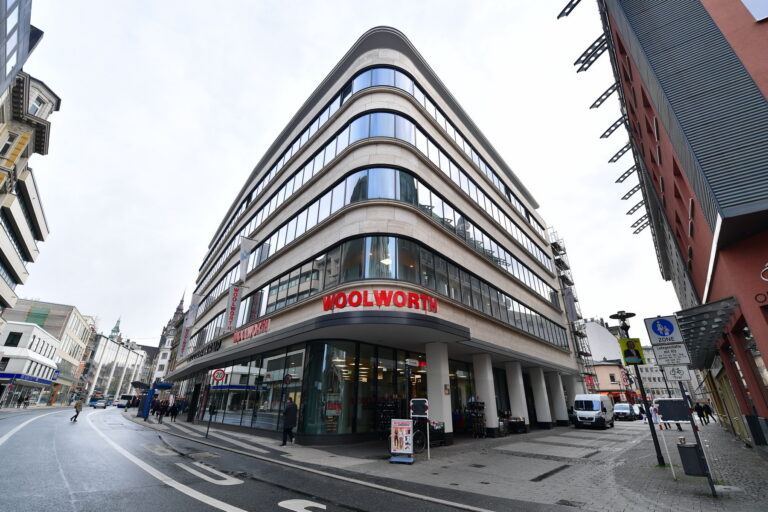
Lower Broadway’s role as “Steamship Row,” including its connections to White Star, Cunard, United States Lines, immigration, and global commerce, is part of the history explored on Woolworth Tours NYC’s A Walk Up Broadway tour. The two-hour historical walking tour follows Broadway from Bowling Green to City Hall Park, connecting nearly four centuries of New York history along one remarkable route.
What the Photograph Can—and Cannot—Tell Us
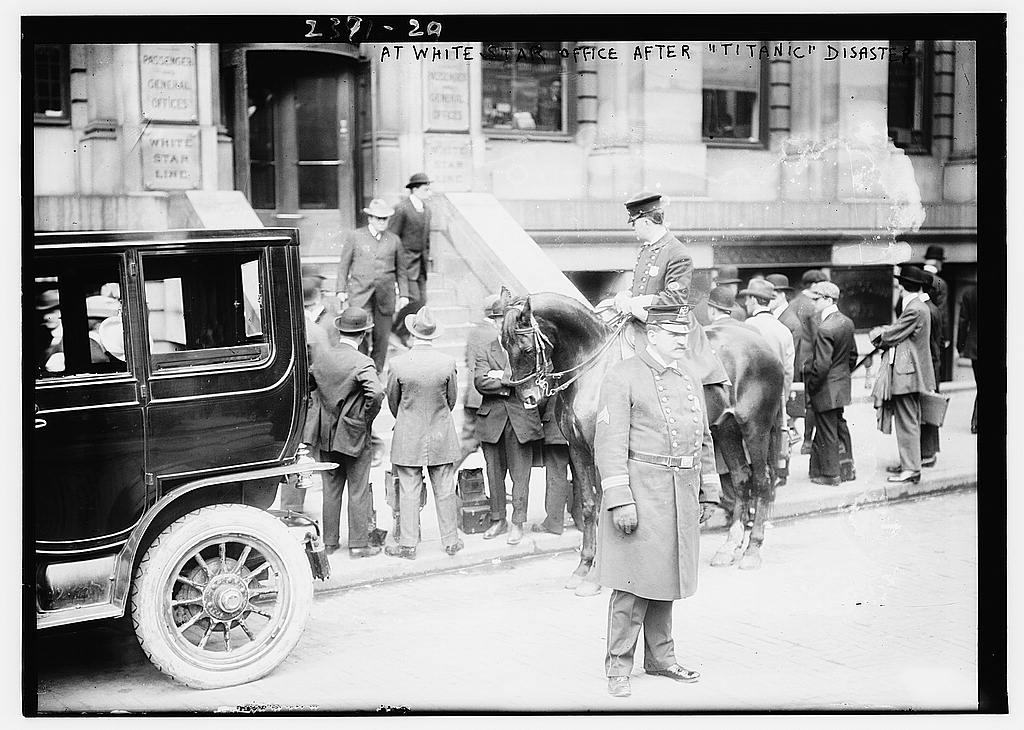
The Library of Congress preserves a Bain News Service photograph cataloged as At White Star Office After Titanic Disaster. Men and women gather near a building; some face the entrance, while others appear to wait or speak among themselves.
The catalog identifies the photograph as relating to the disaster and dates it to April 1912. It also notes that the title came from unverified caption information supplied by the Bain News Service. The record does not independently confirm the exact address, identify every person, or explain precisely what each individual knew at the moment the photograph was taken.
The photograph therefore should not be treated as a confirmed image of the specific crowd outside No. 9 Broadway described by the Tribune.
But it still preserves something meaningful.
The gathering.
The uncertainty.
The waiting.
What Buildings Remember
A building cannot speak.
It cannot describe the voices inside it, the telegrams arriving, the names repeated across a desk, or the moment a person understood that someone they loved would not be coming home.
Yet places hold meaning because people bring their lives into them.
We often walk through Lower Manhattan looking upward. We admire stone facades, carved details, columns, arches, towers, and the extraordinary structures created during New York’s rise as a center of global commerce.
But history also exists at street level.
In doorways.
On sidewalks.
At an office counter where a woman spoke her sister’s name.
At No. 9 Broadway, people once waited for news of the Titanic. They waited for information. They waited for survivors. They waited for the future they had expected to resume.
For many, it never did.
Today, Broadway continues north from Bowling Green through the historic corridor once associated with New York’s great steamship companies. On A Walk Up Broadway, we explore the buildings, businesses, events, and people that shaped nearly four centuries of New York history. The route continues to City Hall Park and includes a rare peek inside the Woolworth Building lobby.
The Titanic never reached New York.
But the fear reached New York.
The grief reached New York.
The survivors reached New York.
And on one April night in 1912, the tragedy reached Broadway.
Sources and Further Reading
- Bain News Service. “At White Star Office After Titanic Disaster.” Photograph, April 1912. Library of Congress, George Grantham Bain Collection. The catalog notes that the original caption information is unverified.
- Encyclopedia Titanica. “Daniel Warner Marvin: Titanic Victim.”
- Encyclopedia Titanica. “Mary Graham Carmichael Marvin: Titanic Survivor.”
- National Archives. “Exhibit: Titanic Memorandum.”
- National Archives. “Survivors of the Titanic Who Were Taken Aboard the Carpathia.”
- New-York Tribune. “1,340 Perish as Titanic Sinks.” April 16, 1912.
- New-York Tribune. “Titanic’s Dead, 1,342.” April 17, 1912. The casualty figures in this early report were later revised.
- United States Senate Historical Office. “Senate Committee on Commerce, Subcommittee on the Titanic Disaster.”
- Woolworth Tours NYC. “A Walk Up Broadway.”